
Requirements
- OS: Windows 10 / 11
- Minimum Build: 17763
- Target Build: 19041
- Architecture: 64-bit / 32-bit / ARM64 (untested)
Installation
- Step 1: Go to the Melora GitHub Releases page.
- Step 2: Download the latest version for your architecture and extract it to a Melora folder.
- Step 3: If FFmpeg is not already installed on your system, download the Windows binaries as well.
Post-Install Setup
After successfully installing Melora via the setup wizard, you'll need to adjust a few preferences on the settings page:
FFmpeg
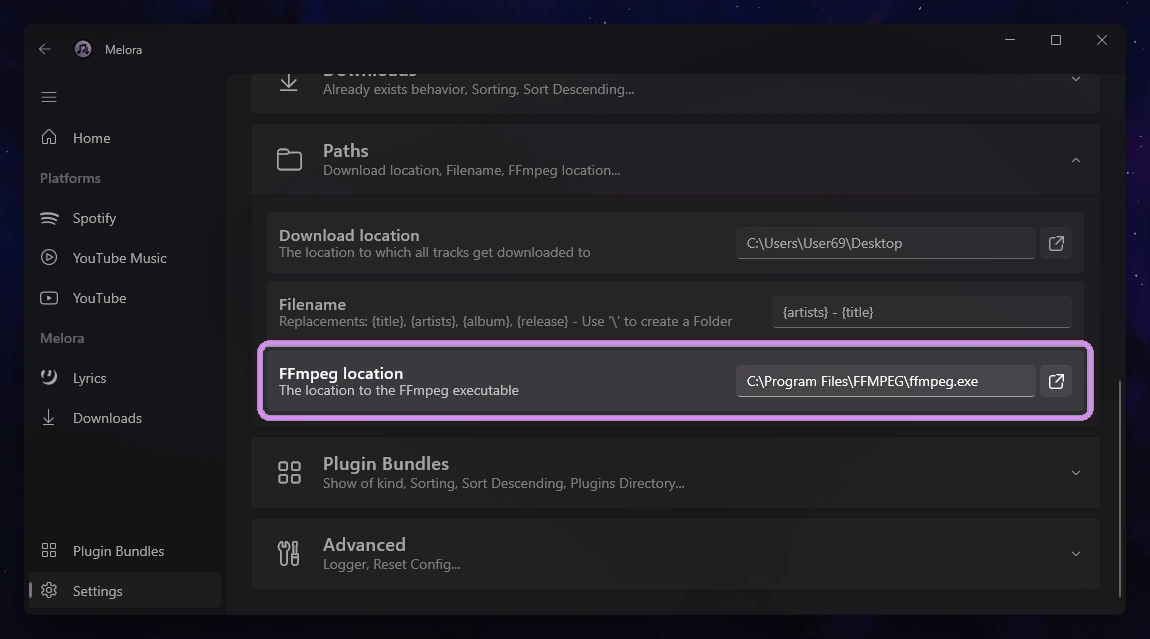
Melora uses FFmpeg internally to encode your downloaded tracks into your desired audio format. To configure the FFmpeg binary, follow these steps:
- Step 1: Open the Melora Settings page.
- Step 2: Expand the "Paths" section.
- Step 3: Click the "Set Executable" button next to the FFmpeg path.
- Step 4: Select the FFmpeg executable you previously downloaded.
Other Paths
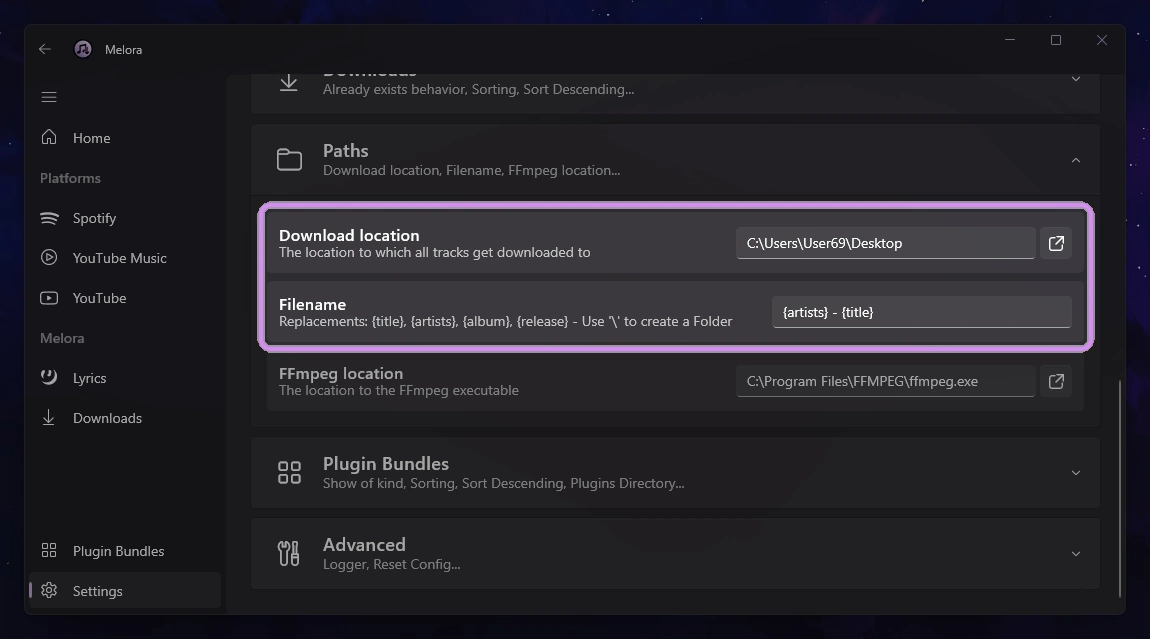
In the Settings menu, you can also specify the download location for your tracks and customize the file name structure using dynamic placeholders.
Available Placeholders:
{title},{album}- Tracl title and albums{artists}- Track artists (defaults toArtist 1, Artist 2, ...){release}- Release date (defaults toMM-dd-yyyy){track}/{tracks}- Album track number / Total track count{disc}/{discs}- Disc number / Total disc count{pos}/{max}- Download queue position / Total queue count
Formatting Options: You can customize how numbers, dates, and artists are displayed by appending a colon (:) and a modifier inside the brackets. For a full list of formats, see the official .NET Formatting Docs.
- Numbers: Add zeros to pad digits (e.g.,
{track:000}➔001,001, ...). - Dates: Use standard date codes (e.g.,
{release:yyyy}➔2026,{release:yy-MM}➔26-06). - Artists: Change how multiple artists are separated:
{artists:first}➔ Only the main artist (Artist 1){artists:&}➔ Joins with an ampersand (Artist 1 & Artist 2){artists:-}➔ Joins with a hyphen (Artist 1-Artist 2)
Folder Organization: To automatically organize your music into folders, use the backslash (\) character. For example, setting the file name to "{artists}\{album}\{track:00} - {title}" will save your track inside an album folder, which is nested inside an artist folder.
Handling Duplicate Tracks
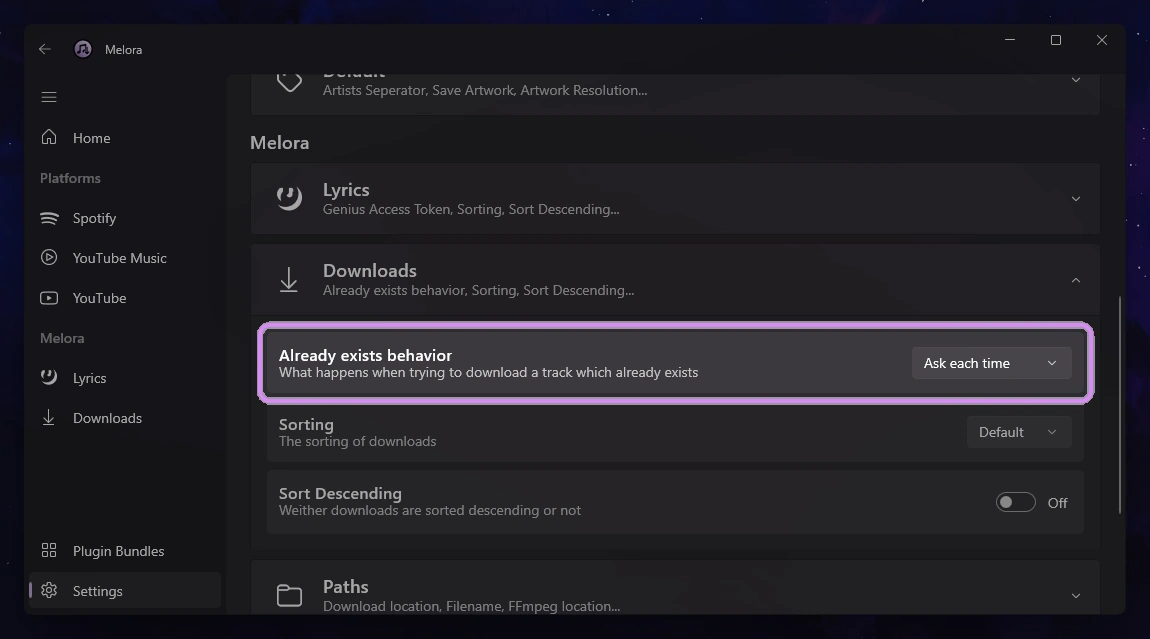
When you attempt to download a track that already exists with the same name, Melora offers several ways to manage this situation. You can adjust the default behavior in the settings, choosing from three options:
- Ask each time: A popup will appear each time a duplicate is detected, prompting you to either overwrite the track or skip it. Note that this will pause the download queue until you provide input, which may interrupt bulk downloads.
- Skip track: The track will be automatically skipped, and a small warning notification will appear. The download queue will continue without interruption.
- Overwrite track: The existing track will be automatically overwritten, and the download queue will proceed without pausing.
Please notice
Plugins are required for Melora to function. They handle searching, track downloads, and metadata writing.
Without plugins, you won’t be able to use Melora. To learn more, refer to the Plugins Guide to get started.